Hello, and happy Monday.
Words to Navigate by: “The first story we tell ourselves isn’t always true.” — The Captain’s Log
Last week, we talked about dragons. Not real dragons, but the ones our imagination sometimes draws in unexplored and unknown places on our mental maps.
Where are we this week?
The Captain’s Chart
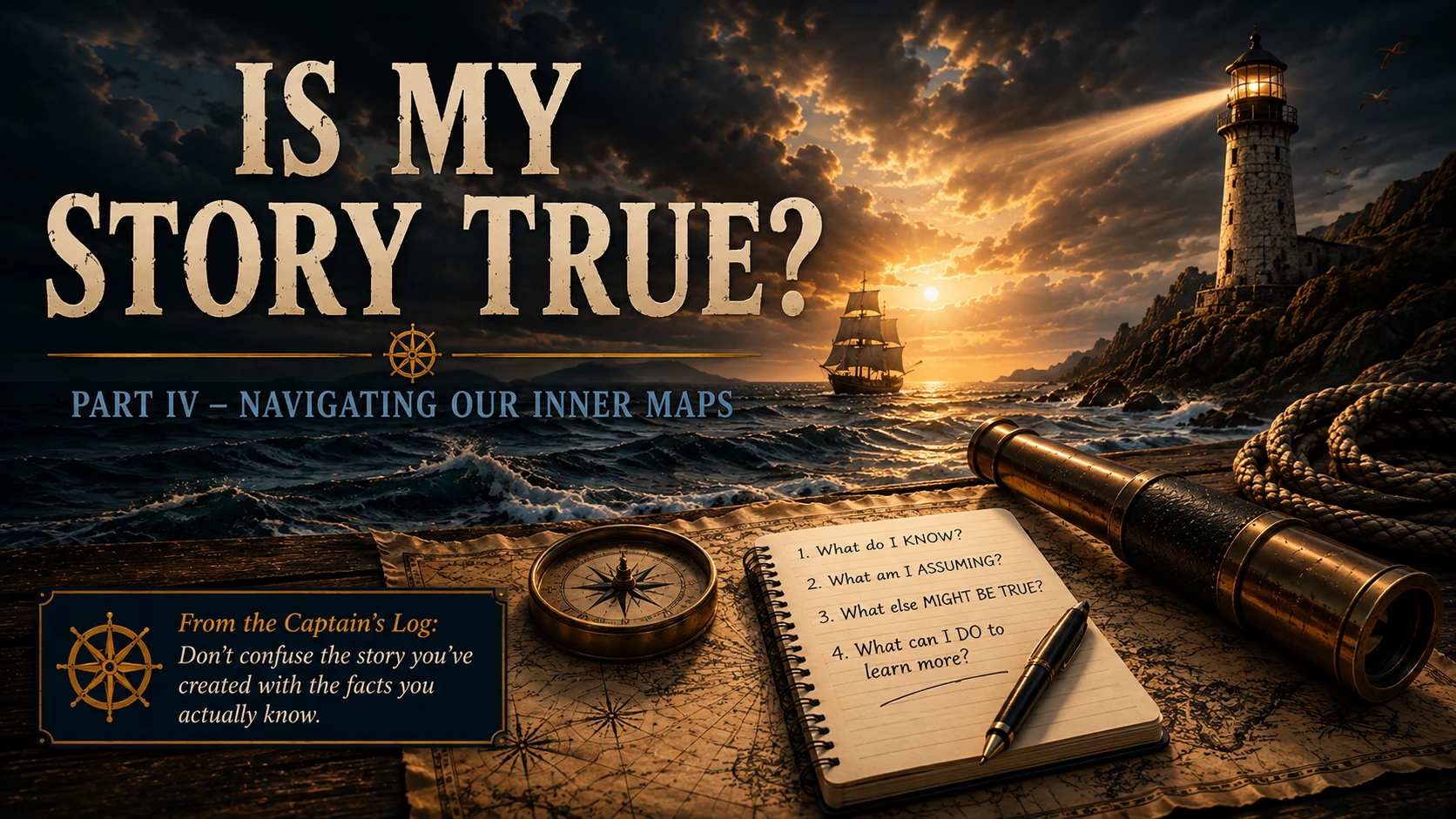
Part IV – Is My Story True?
When we don’t know what lies ahead, our minds, which are not fond of blank spaces, immediately go to work filling in the missing information.
And then, something interesting happens… we begin believing what we’ve imagined is true. As an example: imagine your manager walks past you in the hallway without saying hello.
That’s what happened. That is the only fact we know for certain.
But, almost immediately, other interpretations begin to form in our minds:
-
She’s upset with me.
-
I wonder what I did?
-
Maybe she heard me discounting one of her pet projects.
-
She may have bad news to announce; the rumors have been flying.
-
I know something isn’t right.
Before long, a simple walk down the hallway has become an entire story. But what do we actually know? She walked past without saying hello. That’s it!
Everything else is interpretation… our imaginations working overtime.
Maybe she’s upset with you?
Or maybe she:
-
Is late for a meeting.
-
Is worried about her aging mother.
-
Is mentally preparing for a presentation she is about to give.
-
Is thinking about a difficult conversation she needs to have later that morning.
-
simply didn’t see you.
What else might be true?
I see the same thing happen during times of organizational change.
-
A merger is announced and we think, “They’re going to eliminate my job.”
-
A new software system has been introduced and we tell ourselves, “I’ll never be able to learn this.”
-
A new leader arrives, “Everything we’ve built is about to change.”
-
Retirement gets closer, “I’m going to lose my sense of purpose.”
Could those things happen? Of course.
But there’s an important difference between could happen and will happen.
I’ve noticed something over the years about us humans:
We have a remarkable ability to exaggerate possible negatives while minimizing probable positives.
Perhaps that’s why the stories we create during times of uncertainty so often begin with dragons rather than palm trees.
The problem isn’t that we imagine possibilities. That’s part of being human.
The problem begins when we forget that what we’ve imagined is still only one possible explanation.
Our assumptions quietly become stories. Our stories become conclusions. And our conclusions become beliefs.
Eventually, we begin making decisions and changing our behavior based on a story that may never have been true in the first place.
Brené Brown has written and spoken extensively about this human tendency, often encouraging people to examine what she describes as “the story I’m telling myself.” You can hear Brené describe the concept here.
It’s a powerful idea.
In my own work with leaders and organizations, I’ve found that one of the most useful ways to interrupt this pattern is to slow down long enough to be curious about what we don’t know.
-
We can pause.
-
We can get curious.
-
We can ask questions.
-
We can gather more information.
And then we can decide, intentionally, what we believe. Often with far less stress and anxiety.
The next time you find yourself worried… perhaps ask yourself four questions:
-
What do I know?
-
What am I assuming?
-
What else might be true?
-
What can I do to learn more?
Let’s try these four questions with another example.
Your manager announces that she will retire in three months. No information has been shared about her replacement. Almost immediately, you begin writing the next chapter of the story:
-
They’re probably going to promote someone from inside the department.
-
None of the likely candidates are ready for this job.
-
This could completely change our team.
-
Maybe I should start looking for another position.
Notice how quickly we can travel from one fact, my manager is retiring, to an entire future that hasn’t happened yet.
So, before reacting to the story we’ve told ourselves, let’s check the map by asking four questions:
1. What do I KNOW?
-
My manager has announced her retirement.
-
She plans to leave in three months.
-
No replacement has been announced.
That’s what I know.
2. What am I ASSUMING?
-
I’m assuming her replacement will come from inside the organization.
-
I’m assuming I know who the likely candidates are.
-
I’m assuming one of those candidates will get the job.
-
And I’m assuming that person will make changes I won’t like.
That’s quite a story we’ve constructed from very few facts.
3. What else MIGHT BE TRUE?
-
The company may conduct an external search.
-
There may be candidates I haven’t considered.
-
One of the internal candidates may prove to be an excellent leader.
-
The new leader may make changes that improve the department.
I simply don’t know yet.
4. What can I DO to learn more?
Instead of spending the next several weeks worrying, or adding my own assumptions to the office rumor mill, I could have a conversation with my manager:
“I’m really going to miss working with you. I’m also curious about what happens next. Is there anything you can share about the process for selecting your replacement?”
-
She may not know.
-
She may know but be unable to share anything yet.
-
Or she may provide information that changes my assumptions entirely.
Either way, I’ve replaced some of my speculation with curiosity.
And if the answer is simply, “We don’t know yet,” then perhaps my healthiest response is to acknowledge that there are still blank spaces on the map… and resist the temptation to fill every one of them myself.
Sometimes the four questions don’t produce certainty; sometimes good navigation means becoming more comfortable without having an answer yet.
Sometimes the story we’re telling ourselves will turn out to be true.
But sometimes… there was never a dragon on the map at all.
From the Captain’s Log:
Don’t confuse the story you’ve created with the facts you know for certain.
Captain’s Log Below.
Additional Resources & Related MMM articles:
How will you live, love, or lead, differently, or better, this week?
Sincerely,
Bryan Yager
Do you know someone who might benefit from this weekly leadership minute? If so, please feel free to pass along the subscription link below:
-
On LinkedIn: Click here to subscribe to the MMM newsletter on LinkedIn. (Recommended)
-
Via email: Click here to subscribe to MMM and have it sent directly to your email inbox each Monday.
From the Captain’s Log: “Is My Story True?”
-
“Before you react to the story, check the map.”
-
“Curiosity may be one of our best antidotes to assumption.”
-
“Your first explanation may be possible. That doesn’t make it probable.”
-
“When you don’t know the whole story, leave room for what else might be true.”