Hello and happy Monday.
First a Quote: “Time is more valuable than money. You can get more money, but you cannot get more time.” – Jim Rohn.
This week, I’m in Illinois supporting extended family with a life-transition, so I’m revisiting a Monday Morning Minute first published in December 2021. While the ways we meet continue to change, the need to use one another’s time wisely remains just as important.
How would you answer the following questions:
-
Are you excited about going to your first meeting today?
-
Would you like to attend more meetings this coming week?
-
Do you feel like you don’t get invited to enough meetings?
-
Have you ever sent an email asking to be invited to more meetings?
I suspect not.
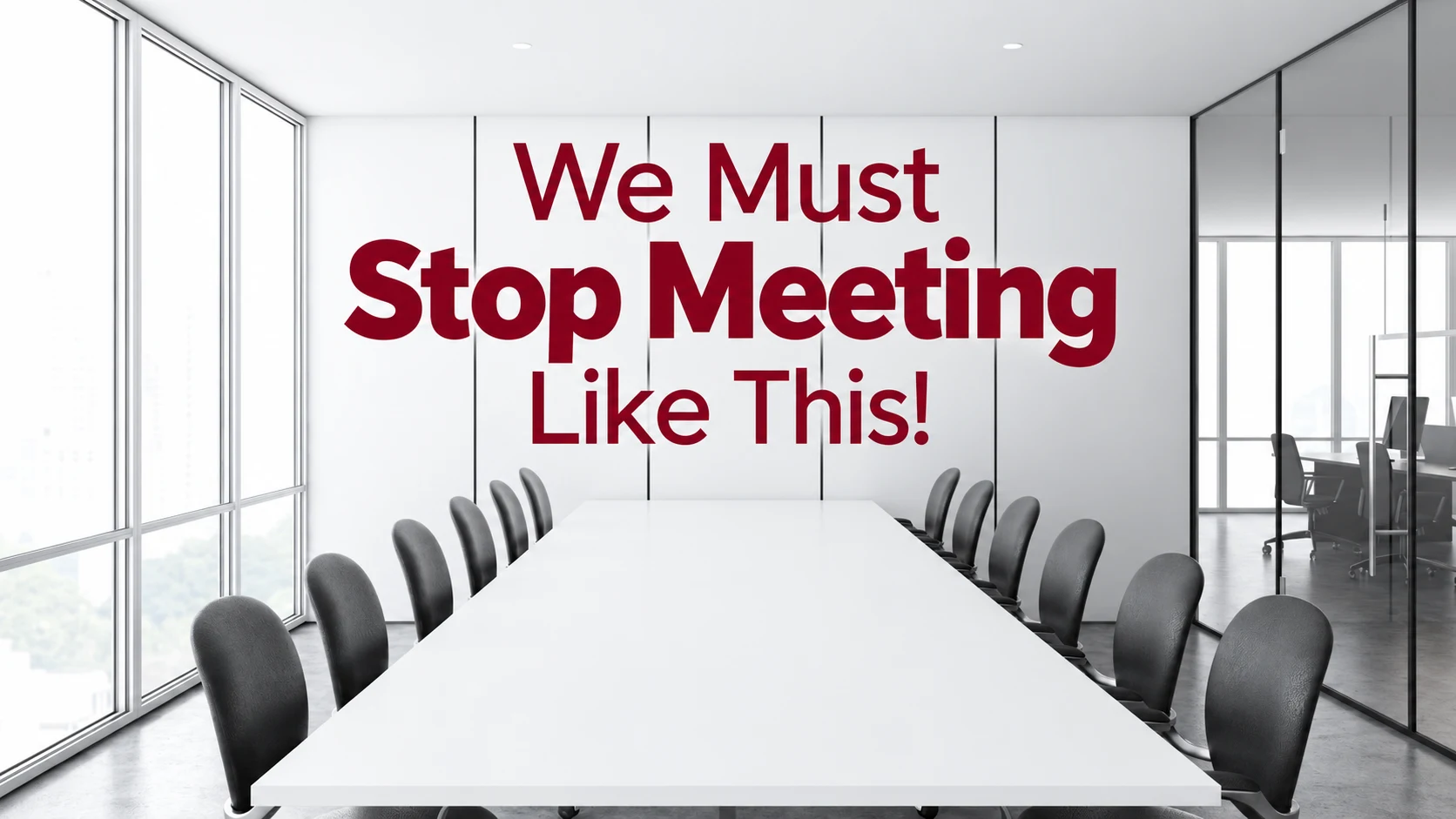
We know meetings are important. They help us solve problems, make decisions, build relationships, and coordinate our efforts. Yet, for many people, meetings have also become a source of frustration.
Too often, we leave meetings wondering what we accomplished, or why we needed to be there.
Whether we meet in person, virtually, or with some combination of the two, the leadership challenge remains the same: How do we make time together worthwhile?
Much could be written about planning and facilitating effective meetings. As an organizational effectiveness consultant, I offer workshops ranging from 90 minutes to eight hours on this very topic.
Today, we can only begin to scratch the surface in a missive intended to be read in under five minutes.
This morning, I offer three simple meeting-management themes for your consideration.
1. Begin with the end in mind.
Before planning the agenda or sending invitations, ask a more basic question: Do we need a meeting?
Could the purpose be accomplished through an email, a shared document, or a brief conversation? Sometimes, bringing people together is exactly what we need. Other times, we may be adding another appointment to already crowded calendars.
If a meeting is needed, be clear about its purpose. When the meeting adjourns, what will be different because you met?
Consider questions like these:
-
What needs to be discussed or decided?
-
Are we gathering information, sharing information, solving a problem, or making a decision?
-
Is our purpose to build relationships or strengthen the team?
-
What actions should follow, and who will be responsible?
Your answers will help determine who needs to attend, how participants should prepare, and how you structure the agenda and conversation. (Just a thought, do all participants need to be present for the entire meeting?)
An agenda identifies what we plan to talk about. Clear outcomes identify what we intend to accomplish.
“Having a meeting on Monday morning because it is Monday is not a good reason to have a meeting.”
— Bryan Yager
2. Meeting on Monday because it’s Monday.
I understand the value of recurring meetings. Weekly or monthly gatherings can provide needed structure, coordination, and connection.
Still, having a meeting on Monday simply because it is Monday may not be a good enough reason to meet.
Recurring meetings deserve the same thoughtful planning as any other meeting. Before gathering, make sure:
-
There is a published agenda with clear topics, expected outcomes, and timeframes.
-
Participants know how to prepare and what to bring.
-
The meeting begins and ends on time.
-
You end the meeting when its objectives have been met—even if time remains.
-
You cancel the meeting, with as much advance notice as possible, when there is no meaningful reason to convene.
Discussions have a way of expanding to fill the allotted time. If we schedule an hour, we often use an hour.
But finishing in 35 minutes is allowed!
Perhaps giving people back 25 minutes would be one of the most appreciated things we could do all week.
3. Conduct regular after-meeting reviews.
Productive teams seek feedback and use it to improve. We can apply that same practice to our meetings.
Occasionally, set aside a few minutes to ask:
-
What works well in our meetings?
-
What could we do differently to make our time together more productive?
-
How often do we need to meet, and for how long?
-
Which topics deserve more attention? Which could be handled another way?
-
What meeting or working agreements would help us?
Then, act on what you learn. Asking for feedback matters. Using it gives people a reason to keep offering it.
Separately, I once had a mentor who asked me to calculate the “hourly run-rate” for every meeting I wanted to schedule. He had me estimate the combined hourly payroll cost of everyone expected to attend, then multiply that figure by the length of the meeting.
For example, if 10 participants had an average hourly payroll cost of $50, a one-hour meeting would represent $500 in payroll alone.
He also asked me to consider the value of each major agenda item in relation to the time allotted to it.
In truth, what he was trying to teach me through that mental exercise was simple: Meetings are expensive. Use them wisely!
He wanted me to understand that, as the meeting planner, I was responsible for making our time together worthwhile.
And the cost wasn’t limited to payroll. While people were in my meeting, they weren’t serving customers, coaching employees, solving other problems, or completing their own work.
Wasting one minute may not seem like much. But with 20 people in the room, it isn’t just one minute. It is 20 minutes of people’s time. Multiply that wasted minute times the number of participants, and the “meeting run rate” established about.
Repeating, meetings are expensive!
Scary, huh?
So, before you head to that first Monday meeting, let me ask:
Which meeting could you shorten, improve, or cancel this week?
Happy meetings!
How will you live, love, or lead differently or better this week?
Sincerely,
Bryan Yager
“Expanding Your Capacity for Success”
PS
Many of the ideas shared in this MMM series also show up in my recently released book, “How to Transition into Leadership …and Why that Changes Everything.”
While the book focuses primarily on management and leadership, the lessons apply just as powerfully to our important relationships outside of work, both personal and professional.
What others are saying:
“ BryanYager has written an excellent book that helps both newly promoted managers and experienced leaders reassess their opportunities for personal growth. I am a business coach, and one of the main challenges for business owners is… if you want your business to grow beyond your personal capacity, you must make the transition from producer to leader-builder.
The success of their company depends on it. Mr. Yager’s book lays out the challenges clearly and the solutions to implement. I have recommended this book to several of my clients, and it has made a difference.”
Dave – Business Consultant
Do you know someone who might benefit from this weekly Monday Morning Minute series? If so, please feel free to pass along the subscription link below:
-
On LinkedIn: Click here to subscribe to the MMM newsletter on LinkedIn. (Recommended)
-
Via email: Click here to subscribe to MMM and have it sent directly to your email inbox each Monday. (Please note I plan to discontinue this service before long. If you’re on LinkedIn, I recommend subscribing with link above.)
Bonus Quotes:
-
“The key is whether it ends with clarity and commitment from participants.” – Patrick Lencioni, on what makes a great meeting
-
“There is nothing quite so useless as doing with great efficiency something that should not be done at all.” – PeterDrucker
-
“Begin with the end in mind.” - Stephen R. Covey,
-
“A single meeting can blow a whole afternoon, by breaking it into two pieces each too small to do anything hard in.” – Paul Graham
-
“Well done is better than well said.” – Benjamin Franklin.