Hello and happy Monday.
Words to Navigate by: “Maps become dangerous the moment we mistake our imaginative view of the unknown for proven geography.” — The Captain’s Log
Three weeks ago, I invited you to stand with me on a metaphorical shoreline.
The “shoreline,” a place we have visited many times*,* is an imaginary dividing line between our past and the future.
Behind us is familiar ground… known, comfortable, predictable, and relatively secure. (Or at least we think.)
Ahead, stretches an expansive, and sometimes stormy ocean, disappearing over the horizon… well beyond our comfort zones. We find ourselves facing significant uncertainty ahead.
It is the great unknown!
The Captain’s Chart – Where are we this week?
The Captain’s Chart
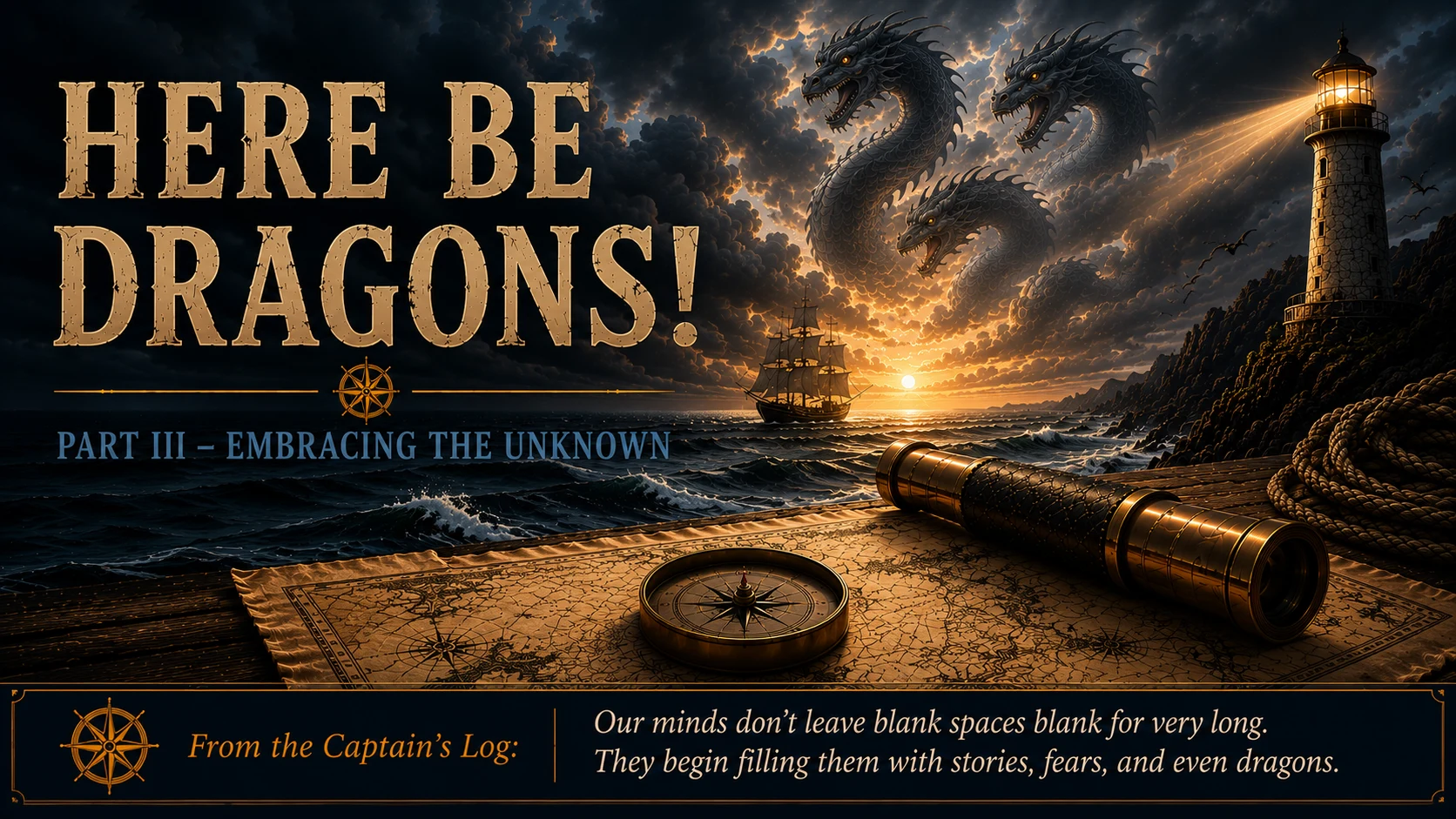
Part III – Here Be Dragons - Embracing the Unknown
Last week, we explored the storms our imagination creates whenever we find ourselves standing on the shoreline of change.
But fear isn’t the only thing our minds create.
Centuries ago, early cartographers (mapmakers) faced a fascinating problem.
They carefully charted the coastlines they had explored; but beyond those familiar waters, there were blank spaces… vast regions of uncertainty. (Kind of how we might look at the night skies today… very large expanses of the unknown.)
Back then, no one knew what lay beyond the horizon. Rather than leaving those blank spaces empty, some cartographers included sea monsters, dragons, and mysterious creatures accompanied by a warning: Here Be Dragons!
“Interestingly… they rarely imagined, ‘Here Be Treasures! ’”
“The cave you fear entering holds the treasure you seek.” — Joseph Campbell
Whether those exact words appeared often on many ancient maps matters less than what they represented. Human beings have always struggled with blank spaces… with what we cannot see or know.
We still do. Only our dragons have changed.
-
A company announces a merger.
-
The loss of a loved one.
-
A promotion becomes available, or denied.
-
Artificial Intelligence begins transforming our work.
-
A doctor schedules additional tests.
-
Retirement starts appearing on the horizon.
-
An adult child leaves home to begin life on their own.
-
A relationship changes.
Very little has actually happened. Yet somehow… our minds are already busy drawing the rest of the map.
“Our minds don’t leave blank spaces blank for very long. Our imagination quietly takes the helm and begins sketching the rest of the map.” - The Captain’s Log
Instead… they begin filling those spaces with explanations:
-
“The new CEO will probably clean house.”
-
“I’m too old to start over.”
-
“They don’t think I’m capable.”
-
“My marriage will never recover.”
-
“Artificial Intelligence is going to replace me.”
None of those statements are facts! They’re simply stories we’ve mistaken for certainty!
Our brains dislike uncertainty, so they naturally search for patterns, explanations, stories, and certainty.
Sometimes those explanations prove remarkably accurate. Often… they don’t.
The challenge is, we rarely know which is which while standing on the shoreline.
Not every dragon is imaginary. Some dangers are very real.
Wise leaders don’t ignore risk.
-
They remain curious.
-
They prepare.
-
They ask good questions.
-
They gather information.
But they refuse to invent additional dangers before the evidence arrives.
There is an important difference between preparing for uncertainty… and becoming imprisoned by it.
I’ve noticed something over the years. Curiosity has a remarkable way of shrinking dragons.
The moment we begin asking better questions… the dragons often become smaller. Sometimes they disappear altogether. Not because the future changed… but because our understanding did.
Perhaps that’s one of the great invitations of leadership. To resist the temptation to immediately explain everything we don’t yet understand.
To become comfortable saying, “I don’t know… yet. Let’s go explore together.”
Those may be the wisest words any leader ever speaks when setting sail into the unknown.
So what?
The next time you find yourself standing on the shoreline of change… pause before allowing your imagination to begin drawing dragons.
Ask yourself:
-
What do I actually know?
-
What am I assuming?
-
Which parts of tomorrow are facts… and which parts have I drawn on the map myself**?**
“The dragons we sketch today… often become the stories we believe tomorrow.” - The Captain’s Log
In two weeks, we’ll take a deeper dive into the “Stories We Tell Ourselves.”
I’m in the early stages of drafting my next book entitled “No Land in Sight; Change Leadership Skills for Work & Life.” I’m using this Monday Morning Minute format to begin writing key chapters of a manuscript over the coming months. As such, I will welcome your reactions, feedback and suggestions. You can help me make it even better.
How will you live, love, or lead, differently, or better this week?
Captain’s Log Below.
Have a great week.
Bryan Yager
PS I’m attending a leadership conference this coming week. I will not be publishing a MMM next week. Thank you for your patience and understanding.
Do you know someone who might benefit from this weekly leadership minute? If so, please feel free to pass along the subscription link below:
-
On LinkedIn: Click here to subscribe to the MMM newsletter on LinkedIn. (Recommended)
-
Via email: Click here to subscribe to MMM and have it sent directly to your email inbox each Monday.
From the Captain’s Log: Here Be Dragons!
-
People rarely resist change because of what they know. The map in our minds is often far more dangerous than the ocean itself.
-
“Most dragons disappear the moment we sail close enough to see them clearly.”
-
“Fear is an imaginative storyteller. Curiosity is a better navigator.”
-
“Maps don’t created dragons. People do!
-
“We suffer more often in imagination than in reality.” – Seneca
-
“The oldest and strongest emotion of mankind is fear, and the oldest and strongest kind of fear is fear of the unknown.” – H. P. Lovecraft