Hello, and happy Monday.
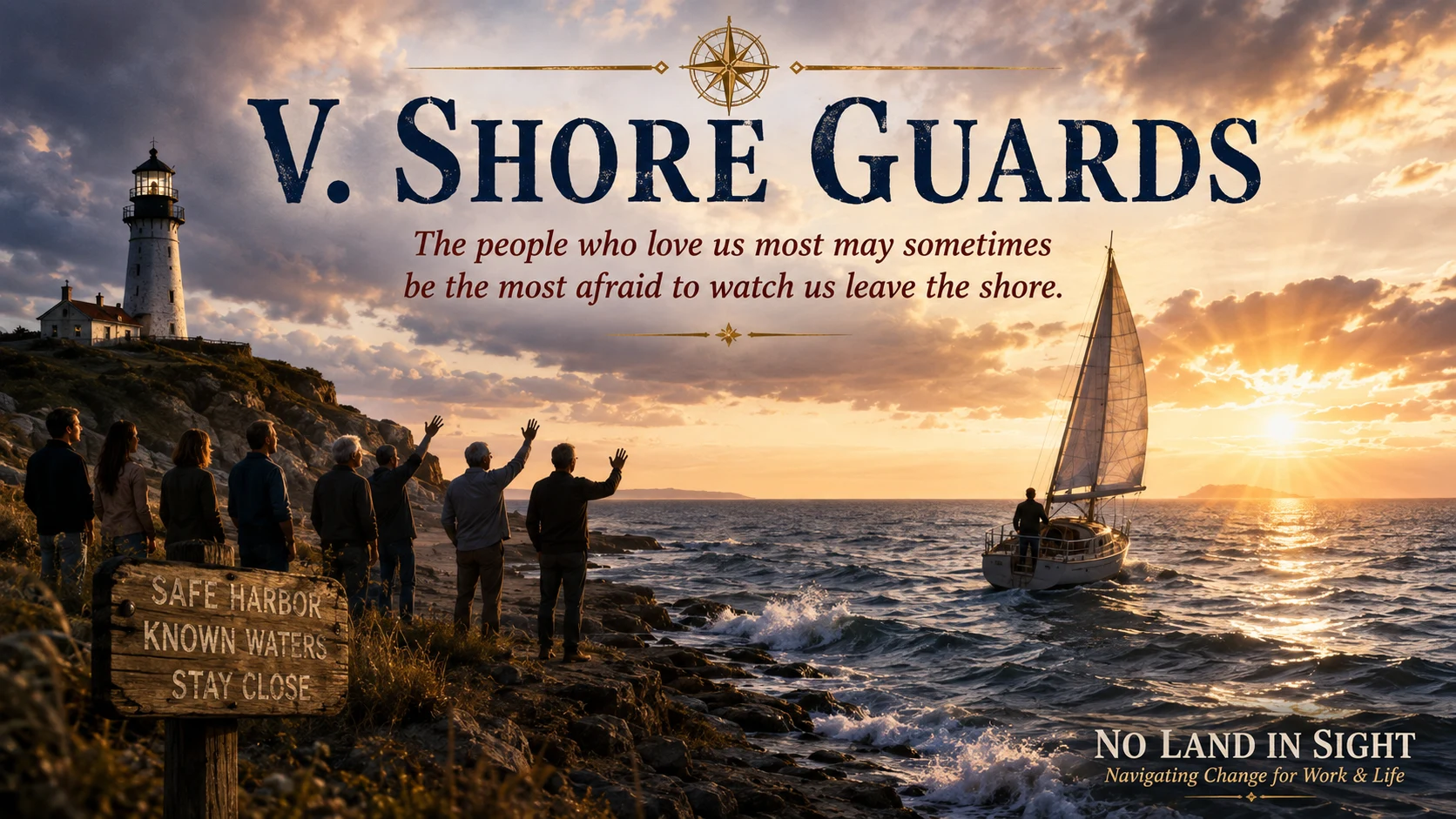
Words to Navigate by: “The people who love us most may sometimes be the most afraid to watch us leave the shore.” — The Captain’s Log
Last week, we talked about the stories we tell ourselves when facing change. But sometimes the voices encouraging us to stay safely on shore aren’t our own. They belong to people who care deeply about us.
Where are we this week?
The Captain’s Chart – Part V: Shore Guards
The Captain’s Chart
Shore Guards
They know us. They care about us. They may have walked beside us for years… maybe even raised us from birth.
And sometimes, just as we begin pushing our boat away from shore, they start reminding us of all the reasons we shouldn’t leave and how dangerous the distant waters may be.
I call them Shore Guards.
Shore Guards aren’t villains. In fact, quite often, they are the people who love us most.
They may be our parents, spouses, friends, colleagues, or managers. Their intentions are usually good. They want to protect us from disappointment, embarrassment, financial loss, failure… or simply from making a mistake we might later regret.
Shore Guards don’t necessarily tell us where we should go. They remind us of everything we could lose by leaving.
When Love Looks Like Protection
I first became aware of this phenomenon many years ago while watching the relationship between my brother-in-law and his mother.
Before I knew the family, my future in-laws experienced something no parent should ever have to go through. They lost their five-year-old daughter to brain cancer. I can only imagine how that kind of loss changes a parent.
Understandably, they became extremely protective of their other children.
Years later, my brother-in-law had a dream. He wanted to become the owner-operator of a pizza restaurant. He was willing to invest some of his retirement savings to pursue it.
His mom was terrified by the possible risks her son was considering.
She repeatedly warned him that the business might fail. He could lose his retirement savings; he could jeopardize the security he had worked years to create.
His mom wasn’t trying to destroy her son’s dream. She was trying to protect him!
I don’t tell this story to suggest his mother was wrong. She had reasons for seeing risk the way she did. Her warnings came from experience, fear… and love. But it raises a question worth considering:
What might my brother-in-law have lost by trying? What might he have gained? And what did he lose by not trying?
The Risk of Leaving, and the Risk of Staying
Years later, I encountered my own Shore Guards as I stood on the shoreline of my future.
I was considering leaving a successful corporate career. I had worked my way into a Vice President role. I had job security, income, benefits, credibility, and a career path many people would have been delighted to have. I also had a young family.
And I was considering walking away from it to start my own consulting practice.
Well-meaning family members, friends, and colleagues warned me about the risks. And they weren’t wrong. There were risks.
-
What if I couldn’t find a steady stream of clients?
-
What if the income wasn’t consistent?
-
What if I failed?
-
What if I discovered that leaving a successful corporate career had been a terrible mistake?
My Shore Guards could see very clearly what I was risking, what I was giving up and what I was leaving behind.
But I could also see something else on the horizon… possibility.
Sometimes we become so focused on the risks associated with setting sail that we forget to consider the risks of staying on the shores of familiarity.
Sometimes the greatest risk isn’t what might happen if we leave the shore. It’s the life we might never live if we stay.
Sometimes We Are a Shore Guard for Someone Else
So far, I’ve written about Shore Guards as though they are other people… people whose concerns we need to listen to without allowing their fears to determine our course.
But there’s another side to this idea that’s equally important.
Sometimes we’re the ones who are working to keep people from leaving the shore.
We become Shore Guards when someone we care about is preparing to take a risk, and suddenly we’re the ones who can see everything that might go wrong.
Years later, this lesson became much more personal for me. My wife and I experienced this phenomenon with both of our adult children as they began navigating their early careers.
For example:
Our son is a successful accountant. One day he invited me to lunch and told me he was considering leaving his very good job.
He wanted to explore entrepreneurship and perhaps an entirely different career.
Suddenly, I wasn’t the person pondering a different future.
I was standing next to him looking out to sea… now I was in the position of being a Shore Guard myself!
I knew how difficult entrepreneurship could be. I knew about inconsistent income, uncertainty, setbacks, an empty checkbook, and sleepless nights.
I also knew our son had a successful career, and I could see what he might be risking.
And because I love him, I felt an internal pressure to protect him and do my part to keep him safe.
At that lunch, I became very conscious of the possibility that I could easily become our son’s unintended Shore Guard.
What was my responsibility as his father?
-
Should I warn him about everything that could go wrong?
-
Should I encourage him?
-
Should I challenge his thinking?
-
Should I tell him what I thought he should do?
Anyone who has been a parent knows these pressures. We all want what’s best for our children.
I wish I had this article to read at the time. (In hindsight, I give myself a B- on walking that line.)
Because I’ve come to believe there is an important difference between helping someone navigate risk and helping someone avoid it altogether.
It can feel like a very fine line to walk.
Shore Guards in Our Workplaces
This same phenomenon happens in organizations. Imagine a talented employee who desires to grow, learn, and advance. They can’t wait for a “stretch assignment” or whatever the next step might be. Her manager, however, might be thinking:
-
She’s doing so well where she is.
-
I’m not sure she’s ready.
-
What happens if I put her in that role and she struggles?
-
Maybe she needs another year.
-
Now isn’t a good time for our business.
Those may be perfectly legitimate concerns.
But sometimes, without realizing it, a well-intentioned manager, coach, or mentor becomes a Shore Guard in someone else’s career.
In our desire to protect people from failure, we can inadvertently protect them from growth.
The same is true with our children.
There comes a morning when a parent walks a young child to school for the first time.
Eventually, we must release that little hand and trust they’re ready for those first steps of growing up.
Then come:
-
Sleepovers.
-
Car keys.
-
Apartments.
-
Careers.
-
Marriage (top of mind for me this week.)
And countless other moments when loving someone require us to loosen our grip.
Sometimes loving someone means resisting the urge to keep them safely on shore.
When You’re the One Preparing to Take the Helm
None of these means we should ignore people whose goals are to keep us safe.
Sometimes the Shore Guards around us can see rocks and storms we’re unable to see. Perhaps they’ve spent years sailing dangerous waters themselves. They may be excellent sources of experience, guidance, and wisdom.
Listen to them. Ask questions. Learn from their experience as you prepare for your own journey.
Check your boat. Study the weather. Make sure you’ve prepared for the voyage.
But before allowing someone else’s fears to determine your course, consider a few questions:
What are they trying to protect?
Listen for the concern underneath their warning. There may be wisdom there.
Are they helping me navigate the risk, or avoid it?
Good counsel helps us prepare for the unknown waters ahead. Fear tells us never to leave the harbor.
What is the risk of staying?
We naturally ask what might happen if we try and fail. Also ask yourself what might happen if we never try or venture beyond your current comfort zones.
Whose voyage is this?
Seek counsel. Listen carefully. Adjust your course when necessary. But don’t automatically hand someone else the wheel.
And when you’re the Shore Guard trying to keep someone safe…
When someone we love, or someone we lead, is preparing to set sail, perhaps our questions need to change:
-
Am I helping this person think and prepare, or fueling their fear of the future?
-
Am I sharing wisdom from my experience, or projecting my experience onto their future?
-
Does this person need my protection… or my confidence in them?
There are times when someone we care about truly isn’t ready. There are rocks they don’t see and storms they haven’t prepared for. Loving them may require us to point out the possible dangers ahead.
And there are also times when our role isn’t to keep them safely on shore.
It’s to help them prepare for the voyage… and then trust them to take the helm. Let’s wave them on with confidence and encouragement!
Captain’s Log Below
How will you live, love, or lead, differently, or better, this week?
PS I will be back on Monday, September 14th. I’m taking two weeks off to enjoy our son’s wedding and extended family in town for the occasion.Thank you for your understanding.
Sincerely,
Bryan Yager
Do you know someone who might benefit from this weekly Monday Morning Minute series? If so, please feel free to pass along the subscription link below:
-
On LinkedIn: Click here to subscribe to the MMM newsletter on LinkedIn. (Recommended)
-
Via email: Click here to subscribe to MMM and have it sent directly to your email inbox each Monday. (Please note I plan to discontinue this service before long. If you’re on LinkedIn, I recommend subscribing with link above.)
From the Captain’s Log: “Shore Guards”
-
Shore Guards don’t necessarily tell us where we should go. They remind us of everything we could lose by leaving.
-
The people who love us most may sometimes be the most afraid to watch us leave the shore.
-
Sometimes the greatest risk isn’t what might happen if we leave the shore. It’s the life we might never live if we stay.
-
The safest harbor doesn’t always yield the safest life.