First a quote: “A person never knows when something they say to another person (sometimes intentionally & carefully, sometimes carelessly and unintentionally) will have a lifelong impact on them; sometimes positively, sometimes negatively.” — Bryan Yager
Hello and happy Monday.
Let’s begin with a question.
Do you remember someone important to you, who said something to you, that you have never forgotten?
Perhaps that person was a parent, maybe a teacher, manager, spiritual leader, or even a friend. It may have been something negative and discouraging, or perhaps positive and inspirational, and those words are still with you today?
I’ll bet most of you can with ease.
Those words, that you might never forget, may have been said intentionally, or carelessly without much thought given by the sender. For many of you, those words left a lasting impression; they may have even partially shaped your self-image to this very day?
Perhaps those words still echo inside your subconscious mind today.
The gist of this article is focused on what we do with those words.
I can give you three personal examples from my life:
-
A high school algebra teacher, in front of the entire class, said to me – “You’ll never amount to much.”
-
On the positive side, a history/shop teacher privately complimented me on my work ethic outside of school. He said my hard work would carry me far in life, and indeed it has. (I often worked one or even two part-time jobs through most of high school.)
-
And one of the most encouraging messages; an undergrad business professor wrote on my final paper, “Bryan, you were a delight to have in this class. You contributed much value to your fellow students, and I personally found you to be both interesting and interested.”
Wow… interesting and interested!
Words I have rarely heard, in any context, before or after. I have never forgotten those words; nor have I forgotten the man that helped change my self-image with a message scribbled on an assignment. (His name was Bob McAyel from Abbott Labs and taught at Lake Forest Graduate School of Management just north of Chicago where I earned my MBA.)
In fact, I now often use those same words when offering feedback to workshop participants and executive coaching clients. (Only when it’s true of course.)
“One kind word can change someone’s day, perhaps even their life.” — Unknown
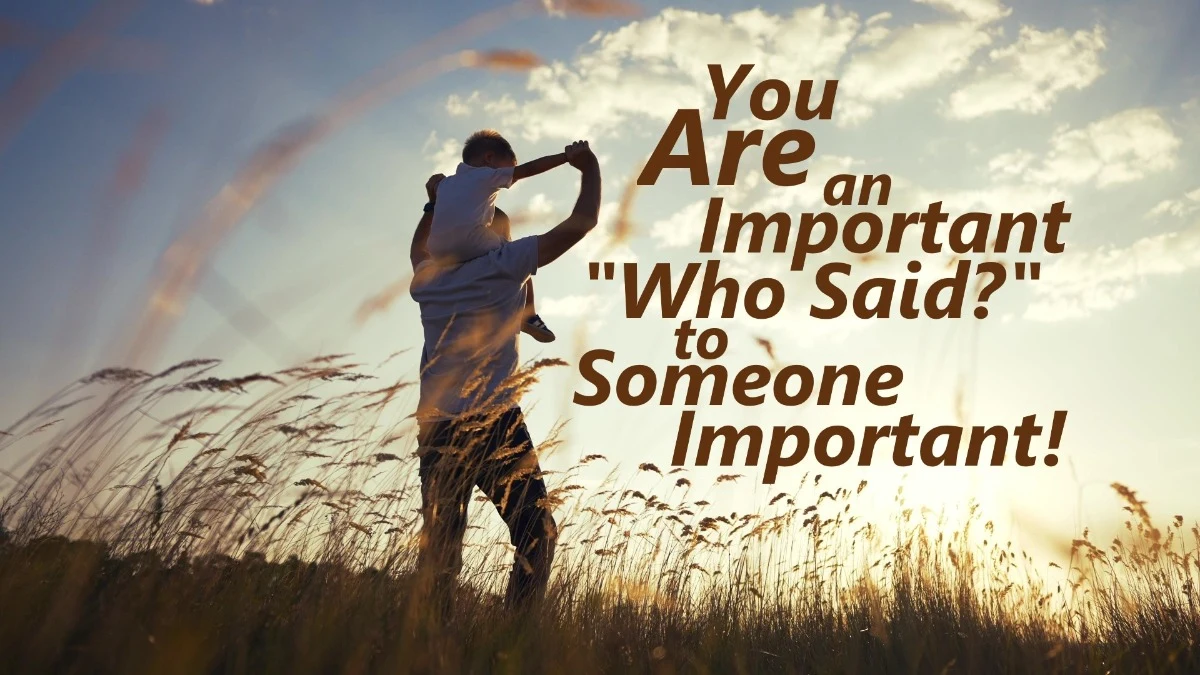
I’m focusing today’s missive on one of two concepts “Who Said? & You Said” which I learned from Lou Tice, founder of the Pacific Institute. (Mastering the Attitude of Achievement audio program)
I’ll focus primarily on the “Who Said” concept for now and perhaps the “You Said” idea at another time.
Lou Tice, (1935-2012) a football coach turned leadership/organizational development coach, introduced the “Who Said?” concept as a powerful tool for challenging self-imposed limitations.
This idea encourages individuals to question the origins of their beliefs, particularly those that may be holding them back from achieving their full potential.
At its core, “Who Said?” is about examining the source of our thoughts, assumptions, self-beliefs and self-image; those that were initiated by words said by others with credibility and importance to us.
Many of the beliefs we carry—about our abilities, intelligence, or potential for success—are shaped by past experiences, or things said by influential figures in our lives, such as parents, teachers, managers, spiritual leaders, or peers.
The math teacher I mentioned earlier was a highly regarded educator and loved in our small community. Many of his students achieved high honors in state competitions for many years.
That made him an important “Who Said?” to me. As an impressionable young person, I assumed he must be right. And at the same time, those words also motivated me to prove him wrong. (Just not in advanced Algebra? 😊)
However, just because someone once said something to us doesn’t mean it’s true, or that it should continue to define us, even years later.
Lou’s approach empowers people to challenge these beliefs and related self-talk by asking:
-
Who said I’m not good enough?
-
Who said I can’t achieve this goal?
-
Who said success is only for certain people?
By questioning these narratives, we can choose to re-frame our mindset, replace negative self-talk with empowering beliefs, and unlock new possibilities.
This is where the “You Said” concept comes into play. How are we talking to ourselves… about ourselves? What is our interpretation of, and response to, those “Who Said?” comments?
Are the stories we’re telling ourselves true. More on that at another time.
Ultimately, Lou Tice’s “Who Said?” approach invites us to break free from limiting beliefs, redefine our potential, and to be intentional about the stories we tell ourselves.
“Life is about choices, and you have the ability to choose. You always have had this ability. I suggest that you not only have the ability, you also have the responsibility to make choices for yourself. It is your life, and you are in the driver’s seat, if you choose to be!” – Lou Tice
Final Thoughts
We can look at this topic through two different lenses.
The first is assessing, and perhaps re-writing, our personal narratives originally planted in our minds by a “Who Said?” earlier in our lives or careers. It is now up to us to write our own narrative and “You Said.”
The second possible lens is to remember, as parents, leaders, managers and coaches, our words matter more than what we might think - we are all “Who Saids?” for other people… including our children.
(See poem by Dorothy Law Nolte below.)
I have an opportunity for improvement in this area. It is too easy for me to assume other people know my intentions are to be helpful and kind.
Those assumptions can lead me to be careless about what I say, how I say it, and who I say it too. I’m a “work in progress.” in this area.
How about you? Is this an area of potential growth for you as well?
How will you live, love, or lead, differently – or better – this week?
Sincerely,
Bryan Yager
“Expanding Your Capacity for Success”
Related Resources and Articles:
-
Click here to buy the audio book - “Mastering the Attitude of Achievement” by Lou Tice (You may find it from other sources of your own choosing.) Lou provides an expanded description of the “Who Said?/You Said” concepts and their applications.
Do you know someone who might benefit from this weekly leadership minute? If so, please feel free to pass along the subscription link below:
-
On LinkedIn: Click here to subscribe to the MMM newsletter on LinkedIn.(Recommended)
-
Via email: Click here to subscribe to MMM and have it sent directly to your email inbox each Monday. (Please note: I plan to discontinue this service later this fall. If you’re on LinkedIn, I recommend subscribing with the link above.)
Bonus Quotes and a Favorite Poem:
-
“Kind words can be short and easy to speak, but their echoes are truly endless.” — Mother Teresa
-
“Change your thoughts and you change your world.” — Norman Vincent Peale
-
“All meaningful and lasting change starts from the inside” ― Lou Tice
-
“Be careful with your words; once they leave your mouth, they can only be forgiven, not forgotten.” — Unknown
-
“Words are singularly the most powerful force available to humanity. We can choose to use this force constructively with words of encouragement or destructively using words of despair.” — Yehuda Berg
-
“A broken bone can heal, but the wound a word opens can fester forever.” — Jessamyn West
-
“Be careful how you are talking to yourself because you are listening.” — Lisa M. Hayes
-
“Talk to yourself like you would to someone you love.” — Brené Brown
-
“Your self-talk is the channel of behavior change.” — Gino Norris
The following is a favorite family poem that Becky and I had hanging in our house for many years. It was written by Dorothy Law Nolte
Children Learn What They Live
If children live with criticism,
They learn to condemn.
If children live with hostility,
They learn to fight.
If children live with ridicule,
They learn to be shy.
If children live with shame,
They learn to feel guilty.
If children live with encouragement,
They learn confidence.
If children live with tolerance,
They learn to be patient.
If children live with praise,
They learn to appreciate.
If children live with acceptance,
They learn to love.
If children live with approval,
They learn to like themselves.
If children live with honesty,
They learn truthfulness.
If children live with security,
They learn to have faith in themselves and others.
If children live with friendliness,
They learn the world is a nice place in which to live.