First a quote: “A leader is one who knows the way, goes the way, and shows the way.” – John C. Maxwell
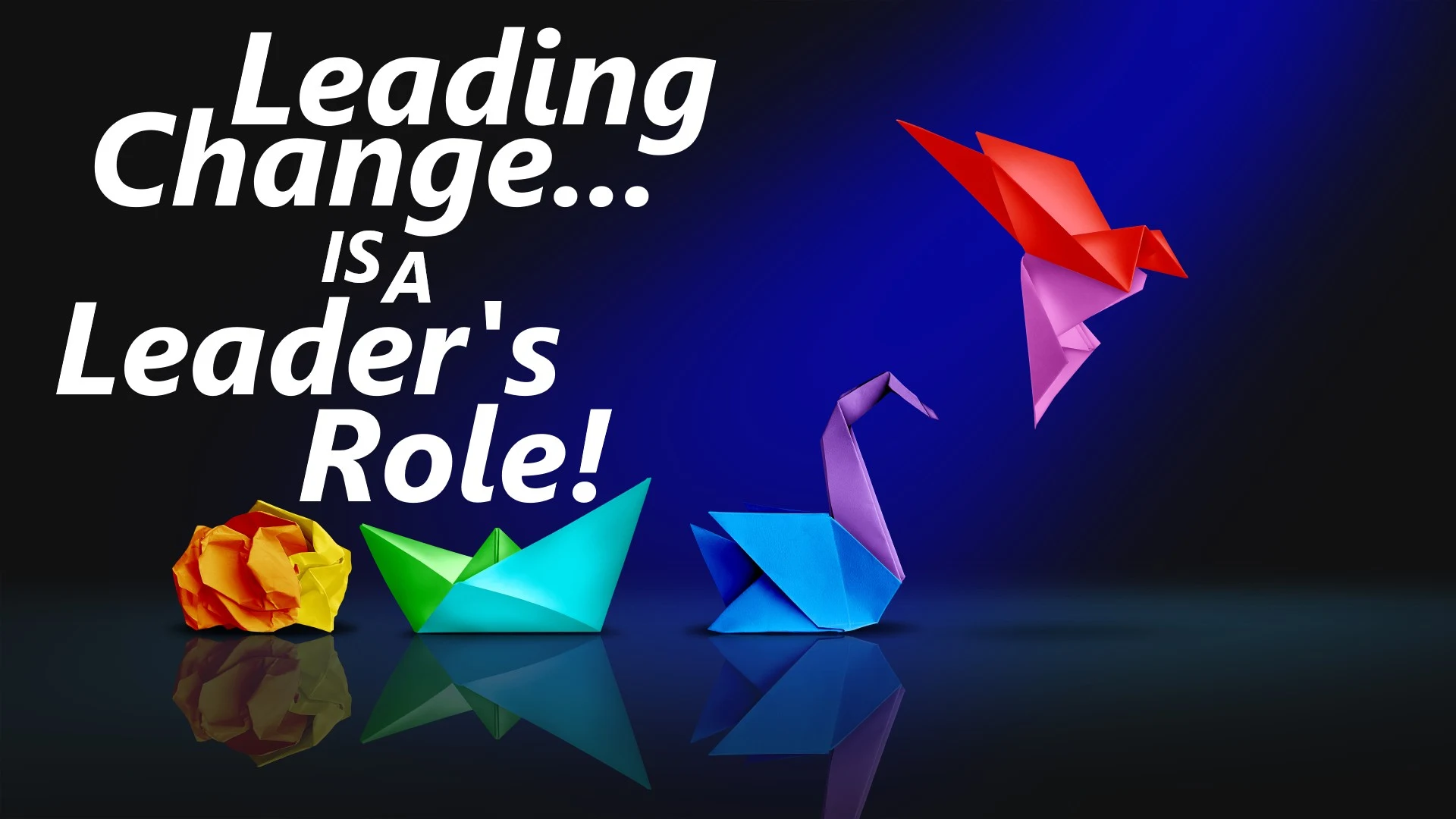
Are you a new manager, or aspiring leader, looking to influence your family, team, department, organization, or perhaps even the world, for the better? If so, here is a thought for your consideration: leadership is connected to change—and change is connected to leadership.
I see one of a leader’s primary roles as leading people, and/or organizations, through change. If you agree with the premise that the future will be different than the present, then it is easy to see that moving through change is a fact of life.
We must learn to transition through change more effectively and help others to do the same.
If we want a better, brighter future, then we must change something we’re doing in the present. It is simply not possible to “have better or different” by doing what we’ve always done!
If all of that is at least generally true, then we must continue to improve in our abilities to lead others through change. What makes this extra difficult is that we will likely be coping simultaneously with change ourselves.
I experienced this going through several large organizational mergers, acquisitions, and/or takeovers, in my career. Not only did I work to help others through difficult transitions, I also had my own family to be concerned about as well.
What about you? Think about when you accepted a promotion that included leading people.
Leading a team, department, or function, comes with responsibilities many aren’t prepared for. It’s not just about overseeing work or keeping the wheels turning. It’s also about guiding people—sometimes gently, sometimes boldly—through what’s next, often when the road ahead is unclear, muddy, or rocky.
In today’s fast-moving world, managing change isn’t enough. Organizations need leaders who can lead change! And there’s a big difference between change management and change leadership.
Through my eyes,
-
Change management focuses on systems, structures, processes, timelines, and Gantt charts. When will things start, stop, or change? It is typically about tasks, processes, and things.
-
Change leadership on the other hand, focuses on people—and the emotional challenges they will need to navigate including their fears, doubts, hopes, and even resistance.
The former is about processes and tasks to be completed. They can be scheduled, tracked and checked off someone’s to-do list. The latter requires awareness, empathy, trust, and emotional intelligence. Change leadership is about the predictable emotional transitions people take in the process.
I’m fond of saying, “The Soft Stuff is the Hard Part.”
Here are a few concepts to tuck into your toolkit:
1. People don’t resist change—they resist loss.
Every change, even a positive one, involves leaving something behind. A process that felt familiar. A team structure that worked. A rhythm that brought comfort. Effective change leaders help others process loss before pushing for progress.
As an example, in the last corporate merger that I was a part of, we had a funeral for the ideas, roles, structures, and even our homes and friends that we were leaving behind as we began the next chapter of our careers. Everyone on our team (that was being relocated) was asked to bring in an artifact to be memorialized in a special event… a funeral of sorts.
The idea, to let go of the old so that we could be freer to move on to the new.
2. Vision matters.
It’s not enough to talk about what’s going away. Leaders must also clearly communicate where you’re going—and why it’s worth the effort, and sometimes the pain.
If you can’t paint a compelling picture of the future, don’t be surprised when your team clings to the past. In change workshops, I often talk about the importance of describing the palm trees on the horizon. Data and facts are not enough. We need to help people visualize what the future will look like, vividly, and clearly.
“If you cannot describe your vision to someone in five minutes and get their interest, you have more work to do in this phase of a transformation process.” – John Kotter
3. Resistance is not the enemy.
In fact, it’s a signal. Pay attention to it. Ask questions. Engage in dialogue. Sometimes resistance is rooted in fear. Sometimes it’s a warning sign about something you’ve overlooked. Change leadership means slowing down long enough to listen—even when you’re in a hurry to move forward. Determining the sources of resistance helps you counteract the sources of resistance while helping people move forward into the acceptance phase of change.
4. Change is emotional, not just logical.
It’s tempting to rely on data, spreadsheets, PowerPoint slides, and bullet points when communicating about a pending change. And, while those things are certainly important, it is usually not enough. Many people make decisions based on emotions, not logic. Especially in times of uncertainty.
Leading through change means connecting hearts before minds. Figure out the “soft stuff” and the “hard part” will become easier.
5. You don’t need all the answers—but you do need to show up.
People don’t expect leaders to be perfect or to have all the answers. They do expect them to be present, honest, transparent, and human. They’ll follow your lead if they trust you’re on the journey with them.
Think back to COVID-19, it wasn’t possible to go to a library, or on-line, grab a leadership book, then go to Chapter 13 to learn how to lead through a pandemic. No one had all the answers. We were learning as we went. No one expected people to have all the answers, they did expect their leaders to be present and engaged.
As the world continues to shift—new technology, evolving expectations, economic disruption—the best leaders will be those who can flex, adapt, and help others do the same.
We don’t need more bosses or change managers. We need more bridge-builders, vision-casters, and courage-givers. What kind of change leader do you want to become?
Bonus quotes below.
How will you live, love, or lead, differently—or better—this week?
Sincerely,
Bryan Yager
“Expanding Your Capacity for Success”
Do you know someone who might benefit from this weekly leadership minute? If so, please feel free to pass along the subscription link below:
-
On LinkedIn: Click here to subscribe to the MMM newsletter on LinkedIn.(Recommended)
-
Via email: Click here to subscribe to MMM and have it sent directly to your email inbox each Monday. (Please note: I plan to discontinue this service in the future. If you’re on LinkedIn, I recommend subscribing with link above.)
Bonus Quotes:
-
“If you do not change direction, you may end up where you are heading.” – Lao Tzu
-
“The greatest danger in times of turbulence is not the turbulence—it is to act with yesterday’s logic.” —Peter Drucker
-
“To improve is to change; to be perfect is to change often.” – Winston Churchill
-
“Leadership is the capacity to translate vision into reality.” – Warren Bennis
-
“The role of leadership is to transform the complex situation into small pieces and prioritize them.” – Carlos Ghosn
-
“Few things are more important during a change event than communication from leaders who can paint a clear and confidence-inspiring vision of the future.” – Sara Clayton