Hello, and happy Monday.
First a quote: “The soft stuff is always harder than the hard stuff.” - Roger Enrico, Former CEO, PepsiCo.
I have facilitated countless change management workshops over the last several decades. It is one of my favorite topics and has been one of my most frequently requested workshops.
I consider myself to be a passionate student on the subject of organizational change. Studying, reading, learning, and continually growing in this area. It is a fascinating topic.
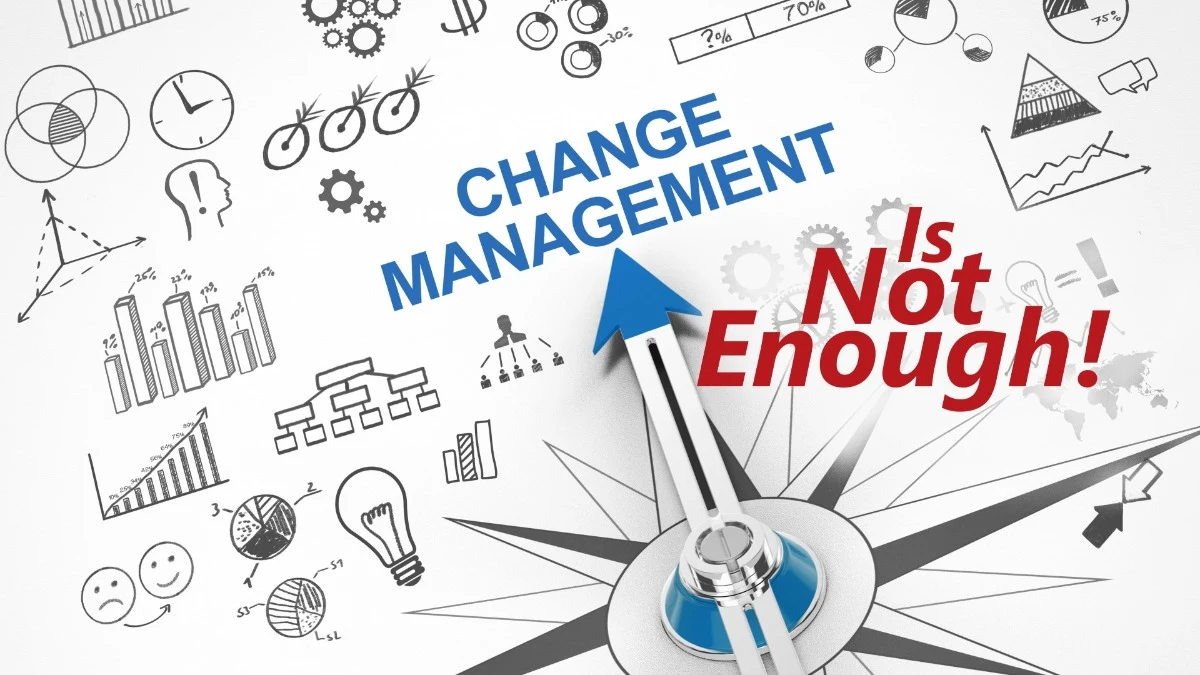
There is significant research suggesting organizations need more change-leadership skills and capacity as opposed to change-management skills.
The research on failed change initiatives is significant!
In fact, according to a recent McKinsey report, organizations undertaking large-scale transformations failed roughly 70% of the time: McKinsey & Company.
And in IBM’s “Making Change Work” study, only about 41% of change projects met time, budget, and quality targets: IBM Public Design Help.
My experience with major change efforts suggests change-management, as a leadership responsibility, is not the most concerning issue. Most change initiatives I have been a part of were fairly well managed and, in most cases, poorly led. Organizations today need more change-leadership, not more change-management.
Why? Because IBM found that when employee engagement is central to designing a transformation plan, adoption of new structures, and technologies, was 34 % higher. IBM and McKinsey point out that leadership behavior, and/or employee resistance, are among the most important drivers of failure.
What is the difference?
Change-management is about the tasks, things, buildings, equipment, and processes involved; what will start, stop, change, be replaced, etc. Change-management is about anything and everything that can be scheduled on a Gantt chart, planning document, or calendar.
There is usually a start, a stop, and a process, or sequence of events, to be managed.
Change-leadership, on the other hand, is about the people. The soft stuff!
“Change is an event, but a transition is the process that you go through in response to the change.” – William Bridges
It is about the emotional transition people must make in connection with significant change. We’re talking about a psychological journey of sorts through the predictable emotional stages of change.
Change-leadership is about helping others navigate through normal and natural reactions to change. As much as we may want to tell others to simply “get over it” and move on, people must go “through the process” of change.
Moving through the emotional stages of change is also a process. These psychological transitions cannot be scheduled, planned, or put on a Gantt chart. It is about the “soft stuff” and as Roger Enrico said:
“The soft stuff is the hard part.”
Let’s take relocating your family to a new home, perhaps in a new state, as an example.
The change-management list will be long and perhaps feel overwhelmingly complex. A brief sampling of the list might include:
-
finding a new home or apartment
-
getting out of your current lease or selling your existing home
-
finding new service professionals including barbers and beauticians, dental, medical and insurance providers
-
researching schools
-
renting a moving truck
-
forwarding your mail
-
getting a new driver’s license and updating utilities companies
Again, just a short sampling of a very long list to be planned, scheduled, and managed.
Change-leadership, also just a sampling, could include:
-
supporting your family while informing friends and relatives of the move
-
saying good-bye to special people and groups
-
sorting, packing, and perhaps disposing of favorite possessions
-
finding new friends and new social gatherings like churches, clubs, or sporting groups
It will require going through loss and separation while still working through the uncertainties of your family’s new environment and looking forward with anticipation.
I have seen research placing home relocation as one of the top 10 sources of personal stress, often straining marriages and other family ties.
If you have ever relocated teenagers, you know first-hand what I’m referring to.
I’m not suggesting change-management, as a skill and leadership responsibility, is unimportant, clearly it is extremely important to the success of any change event.
I am, however, suggesting change-leadership doesn’t get nearly enough attention and often gets short shrift compared to the time and effort invested managing the “hard stuff.”
Always remember, the soft stuff is the hard part when leading change.
It is also important to make any change effort successful. If you reflect back on change initiatives you have experienced in your life and career, I think you will find this to be true.
Bonus Quotes Below.
Additional Resources:
Articles:
-
Click here to read: The State of Organizations; McKinsey & Company; 2023
-
Click here to read: Building a 21st Century Leadership Factory; McKinsey & Company
-
Click here to read: Organizations do not change. People Change!
Videos:
-
Click here to watch: Common Pitfalls in Transformational Change Efforts; McKinsey, March 29, 2022
-
McKinsey Podcast: How to double your odds that your change program will succeed.
-
McKinsey - The secrets of transformations; the elements of success.
Suggested Reading:
How will you live, love, or lead, differently, or better, this week?
Do you know someone who might benefit from this weekly leadership minute? If so, please feel free to pass along the subscription link below:
-
On LinkedIn: Click here to subscribe to the MMM newsletter on LinkedIn. (Recommended)
-
Via email: Click here to subscribe to MMM and have it sent directly to your email inbox each Monday.
Bryan Yager
“Expanding Your Capacity for Success”
Bonus Quotes:
-
“The greatest danger in times of turbulence is not the turbulence – it is to act with yesterday’s logic.” – Peter Drucker
-
“Nothing so undermines organizational change as the failure to think through the losses people face.” – William Bridges
-
“If you do not change direction, you may end up where you are heading.” – Lao Tzu
-
“Change cannot be put on people. The best way to instill change is to do it with them. Create it with them.” – Lisa Bodell
-
“The central issue is never strategy, structure, culture, or systems. The core of the matter is always about changing the behavior of people.” – John P. Kotter
-
“Few things are more important during a change event than communication from leaders who can paint a clear and confidence-inspiring vision of the future.” – Sarah Clayton
-
“One can choose to go back toward safety or forward toward growth. Growth must be chosen again and again; fear must be overcome again and again.” – Abraham Maslow