First a quote: “You can’t do the work of tomorrow if you’re consumed by the tasks of today.” — Unknown
Hello and happy Monday.
Reflecting on my own journey to becoming a manager, I remember my first significant role in the world of people development. I had been tasked with training first-time managers as they transitioned from individual contributors to department manager roles.
At the time, our company policy was to send new managers to a program called SST (Supervisory Skills Training) only after they had been in their roles for six to nine months.
My belief was we should train people before they were promoted—not after.
I raised the issue with my boss and mentor, Ed Buron, a man I respected deeply.
His response:
“Bryan, before becoming a manager, most people think being a manager will be easy—and it’s not! We want SST participants to come to class hungry to learn, after they’ve experienced first hand the challenges that come with the title.”
He was right—at least in that environment and point in time. Ah yes, learning from the wisdom of experience.
Today, I want to focus on just one of the many mental shifts required to grow as a successful manager and leader.
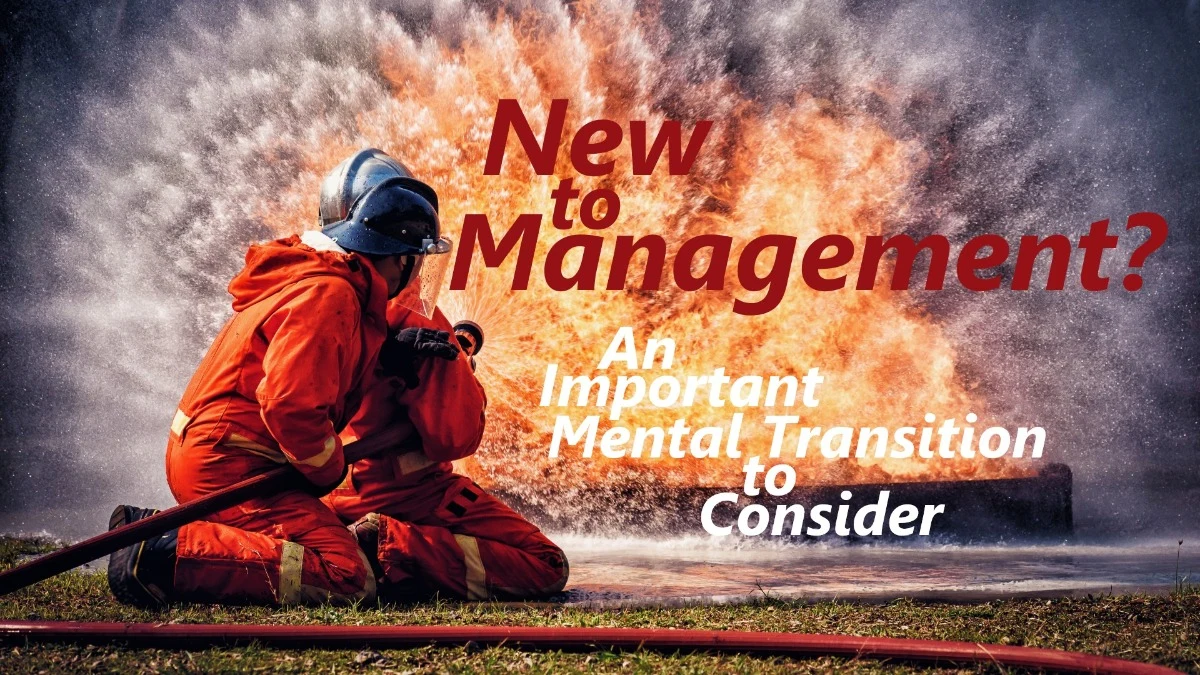
As a first-time manager, one of the biggest mindset changes you’ll face is moving from being a firefighter —solving urgent problems all day—to becoming a fire prevention expert —proactively building systems, improving processes, developing people, growing a team, and identify potential problems before they start.
This is about learning strategic management. Perhaps a topic for another day.
This shift is often described as moving from “working IN the business” to “working ON the business. ((Concepts made popular in Micheal E. Gerber’s top selling book, The E Myth.)
Working IN the business means staying close to the action—responding to the fires and problems of the moment, handling daily tasks, and making sure things get done. It’s often reactive and feels a lot like “fighting non-stop fires.” The things you’ve proven you can do well.
If you’ve recently been promoted into a first management role, congratulations!
And welcome to what I like to call The Transition Zone —that confusing middle ground between what got you to this point, and what is now expected of you going forward. Quite often, people are promoted to new roles without ever being trained, or warned, about the mental transitions yet to be made.
Working ON the business means stepping back to see the bigger picture—thinking proactively, improving systems and processes, coaching people, developing your team, and preventing fires from starting in the first place.
This is about shifting from doing the work to enabling others to succeed and building a stronger foundation for the future.
This transition won’t happen overnight and without a lot of intentional effort, but embracing it is key to becoming a more effective and successful manager.
Let me explain further.
As individual contributors, our value is often defined by the quality, speed, and volume of our personal output… delivering results! Writing reports. Solving problems. Handling many of the important tasks yourself. And chances are, you have done these things really well—that’s part of what earned you the promotion.
With your promotion to manager, things have likely changed, including how your results, as a manager, will be measured.
Your job isn’t just about the work you get done anymore. Your new job is to ensure that work gets done well through others, through your team! In all likelihood, while still being asked to be a “working manager,” wearing more than one hat.
This subtle distinction is easy to understand intellectually—but much harder to embrace behaviorally.
“A good manager finds satisfaction in helping others be productive, not being the most productive person in the room .” – Paul Glen
Simply put: your greatest contribution is no longer doing ; it’s your leading! It is no longer about your personal productivity but that of your team.
What does “working on the business” really look like?
It means stepping back and zooming out to see the bigger picture. To “get out of the weeds,” to rise above the chaos. (I often call this “going to the balcony” to see a bigger, broader picture.)
Thinking longer-term. Instead of being the person who jumps in to fix a problem, you’re the one creating processes or procedures that might prevent the problem in the first place.
You’re looking at the big picture: capacity, culture, clarity, capability including systems and structures.
Here are a few signs that you’re stuck working in the business:
-
You’re the hero who saves the day… every day.
-
You measure your worth by how busy you are.
-
You say, “Delegating? It’s just faster if I do it myself.”
-
You don’t have time to think because you’re always busy doing.
And here’s what it looks like to start working on the business:
-
You delegate with intention. Planful delegation can be used to grow your team’s capacity, not just moving things off your plate and on to theirs. See Develogate article below.
-
You coach others instead of taking over.
-
You carve out time for strategy, not just activity.
-
You focus on building people and teams, not just solving problems.
Think about it this way, any time you do the work that someone else is being paid to do, (who may have used the experience to learn and grow) you’re robbing them of a developmental opportunity.
One big challenge:
This transition can feel uncomfortable—especially at first. You might feel guilty. Useless. Even disconnected. But that’s normal. You’re not being lazy. You’re growing and helping team members grow too.
And make no mistake: this transition is a promotion of trust—your organization is trusting you with more than just tasks; they’re trusting you with direction and the productivity of your team.
One helpful question to ask yourself:
“Am I solving this because I’m the best person to solve it, or because I haven’t helped someone else learn how?”
Final thoughts:
Leadership is less about doing things right and more about making sure the right things are being done.
The more time you spend working on the business—developing people, improving systems, clarifying vision—the more effective your team will be. And that is the true work of an effective manager/leader.
So… how will you spend your time this week? In the business? Or, On the business?
Related MMM Articles:
How will you love, live, or lead, differently, or better, this week?
Sincerely,
Bryan Yager
“Expanding Your Capacity for Success”
Do you know someone who might benefit from this weekly leadership minute? If so, please feel free to pass along the subscription link below:
-
On LinkedIn: Click here to subscribe to the MMM newsletter on LinkedIn.(Recommended)
-
Via email: Click here to subscribe to MMM and have it sent directly to your email inbox each Monday.
Bonus Quotes:
-
“A good manager is a man (person) who isn’t worried about their own career, but rather the careers of those who work for them .” H.S. Burns
-
“Every good leader is part manager, and every good manager is part leader.” — Condoleezza Rice
-
“The true genius of a great leader is his or her ability to individualize. A great manager is one who understands how to trip each person’s trigger.” – Marcus Buckingham
-
“The question is not whether or not you have influence, but what you will do with the influence you have.” – Joe Girardi
-
“Good management consists in showing average people how to do the work of superior people .” — John D. Rockefeller
-
“Treat employees like they make a difference, and they will.” — Jim Goodnight
-
“Leadership and learning are indispensable to each other.” — John F. Kennedy