First a quote: “Bad people doing bad things is not interesting. What I find interesting is good people doing bad things.” – Amy Bloom
Hello and happy Monday.
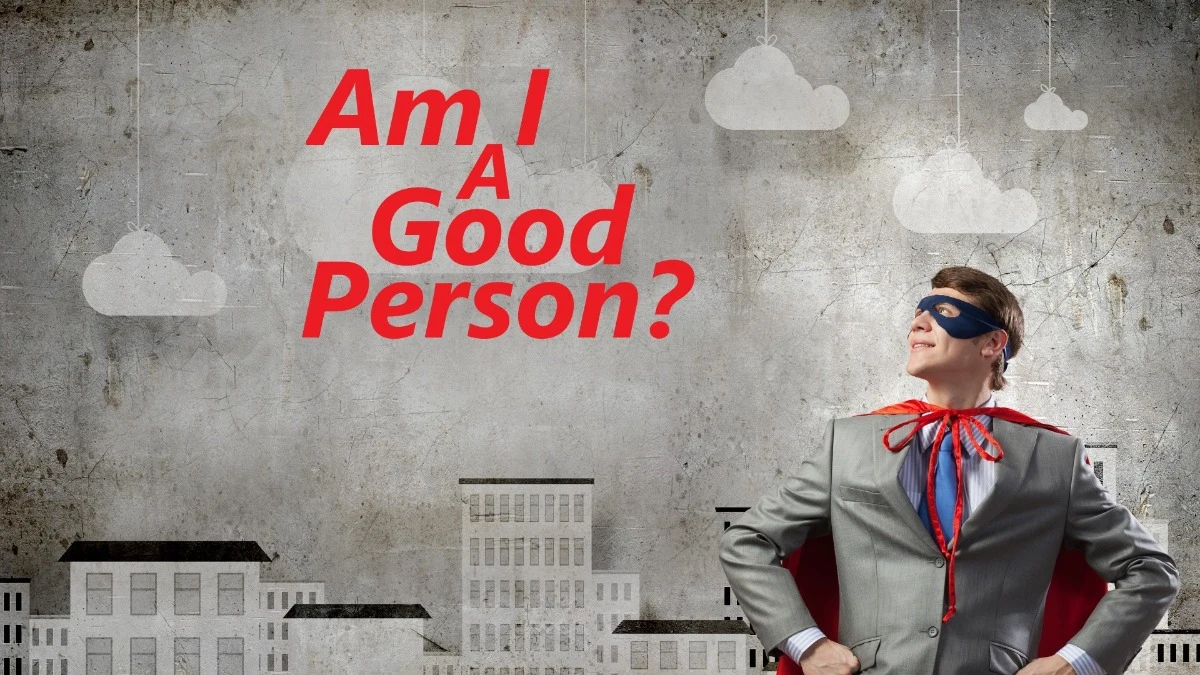
Are you a good person? Am I a good person?
For me, this is akin to asking a group of people if they are “better than average” drivers. Believe me, when I ask this question in workshops, almost everyone (almost always) sees themselves to be “above average” as drivers.
If you understand basic math, you know it is not possible for 100% of us to be “above average.” Yet, it is a rare person who describes themselves as being “below average” as a driver.
I’m proposing the same would be true if we asked people if they see themselves as being a “good person.” Who doesn’t like to see themselves as a being a good person, who may occasionally do bad things?
If you asked me if I were a good person, my mind would instantly race to find a myriad of examples that I could use as evidence of my obvious qualities of goodness.
For instance, I might quickly rattle off:
-
My life’s passion of helping others to grow and experience greater levels of success.
-
Being raised in a faith-based home and have attended church most of my life.
-
I can be generous in helping to feed the hungry and homeless; and donating time and money to other causes I care about.
-
Being a loyal and loving husband and father.
-
Helping elderly neighbors with yardwork or shoveling after a heavy winter snow.
However, I also know my subconscious mind is capable of incredible levels of self-deception about a more accurate truth… I am not nearly as “good” as I would like to think I am or, would like for others to perceive I am. (See suggested book title below.) For instance:
-
When tired or stressed, I can be quick to anger or display a more critical nature.
-
It is all too easy to be judgmental and critical of others with different beliefs or faiths.
-
When behind the wheel, I am frequently impatient with other drivers.
-
Sometimes, when I have needed to be “my best self” as a friend, leader, parent, or spouse, I have been at my worst.
-
I am quick to rationalize, or justify my poor behaviors, while not giving others the same grace.
How about you?
If you want to see examples of this phenomenon in action, simply spend a few minutes on any social media platform and look at what seemingly “good people” are posting, liking, and/or sharing.
Why is it that so many “good people” are posting or promoting hate, vitriol, and contempt?
Why is it that so many “good people” who might talk about the importance of loving others one day, have no problem role modeling something very different another day.
Even the best among us sometimes makes poor choices, leaving others to wonder, “How could they do that?” or “Why would they say or post that?” or “Gosh, that is so unlike them.”
Human behavior is complex! Even fundamentally good people can act in ways that are contrary to their professed beliefs and values.
Here are four possible explanations of these behaviors for your consideration:
-
Stress and Pressure – High-pressure situations (like during our current election environment) can narrow our focus to one of self-preservation, leading to actions we wouldn’t ordinarily take. Instead of being at our best, we tend to be at our worst. For example, an exhausted parent might lash out at a child not because they are cruel, but because their emotional resources are running on empty.
-
Group Influence and Peer Pressure – Social dynamics can heavily influence our behavior. People tend to conform to the norms of a given group, even if it means compromising their values and/or principles. Fear tends to be a detrimental emotion for most of us.
-
Emotional Triggers – Anger, fear, jealousy, and/or insecurity can cloud our judgement and lead to regrettable actions. By far, most of the political ads running today tend to be negative or fear-based and intended to drive emotional responses. All of us are vulnerable to emotions that can drive rationalization and justification for inappropriate reactions and responses.
-
Moral Licensing – People who perceive themselves as “good” might unconsciously feel they’ve earned the right to bend the rules. This phenomenon, known as moral licensing, suggests that after doing good deeds, people may give themselves permission to act or speak poorly, believing their past actions will justify their poor behaviors.
My parents used to say, “Don’t let the poor behaviors of others be a reason for poor behavior on our part.”
With approximately two weeks to go until election day, I encourage all of us to focus on being our “best selves” in the days and weeks ahead.
Everyone can make a difference, and everyone should try.
Related Resources :
-
Ted Talk: How to let go of being a “good” person — and become a better person | Dolly Chugh
-
Book: Leadership and Self-Deception (I recommend this book to most of my coaching clients)
Bonus Quotes below.
How will you live, love, or lead differently, or better, this week?
Sincerely,
Bryan Yager
“Expanding Your Capacity for Success”
Do you know someone who might benefit from this weekly leadership minute? If so, please feel free to pass along the subscription link below:
-
On LinkedIn: Click here to subscribe to the MMM newsletter on LinkedIn.(Recommended)
-
Via email: Click here to subscribe to MMM and have it sent directly to your email inbox each Monday. (Please note: I plan to discontinue this service soon. If you’re on LinkedIn, I recommend subscribing with link above.)
Bonus Quotes:
-
“Do your little bit of good where you are; it’s those little bits of good put together that overwhelm the world.” – Desmond Tutu
-
“Bad things happen when good people pretend nothing is wrong.” – Corey Taylor
-
“There are more honest people and more good people than there are thieves and bad people. It’s just always been that way.” – Michael Nesmith
-
“Good people do not need laws to tell them to act responsibly, while bad people will find a way around the laws.” – Plato
-
“Associate with men of good quality if you esteem your own reputation; for it is better to be alone than in bad company.” – George Washington
-
“Beautiful people are not always good, but good people are always beautiful.” – Ali ibn Abi Talib
-
“Good people know about both good and evil: bad people do not know about either.” – C.S. Lewis
-
“Waste no more time arguing what a good man should be. Be one.” – Marcus Aurelius
-
“Let us be grateful to people who make us happy, they are the charming gardeners who make our souls blossom.” – Marcel Proust